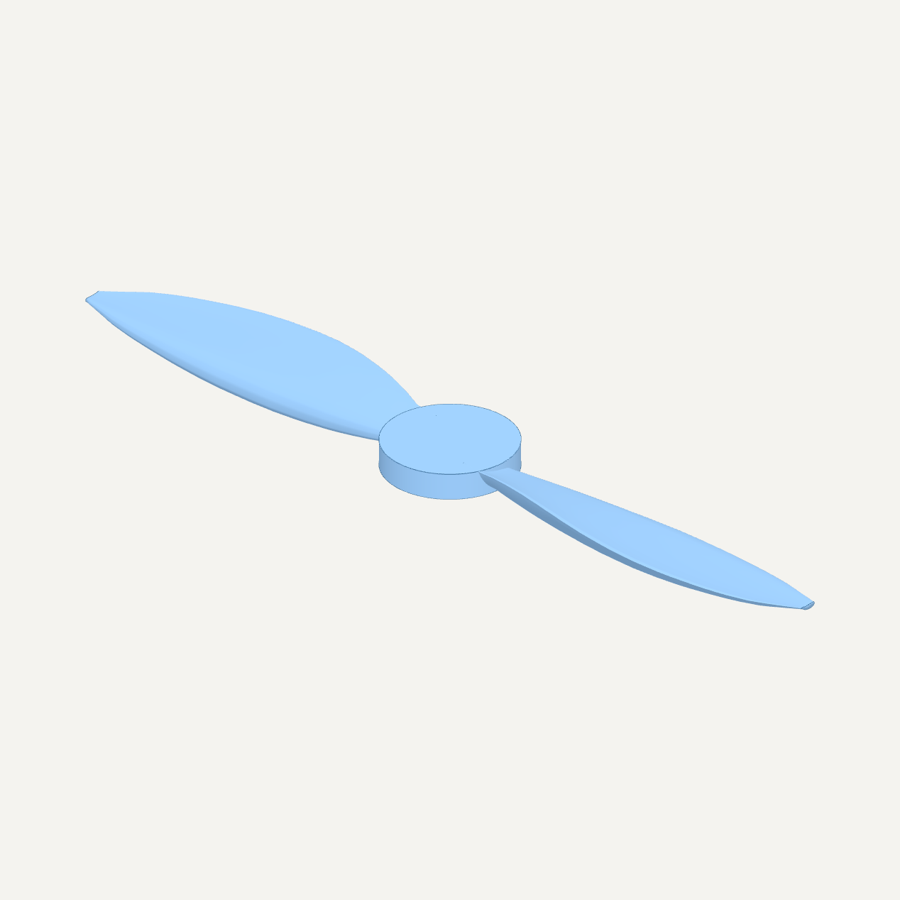
Water is 830 times denser than air. Put a normal drone propeller underwater and the motor stalls, wasting 97% of the battery's power. Archimedes redesigned the propeller and its gearbox together.
Stock drone propstalls its motor underwaterArchimedes designswept blade, two-speed gearbox
~90%as good as a propeller built only for air, or only for water
20 hours12 of agent search plus 8 of checks, about $160 of compute
1,251designs tried by six teams of agents
The ask
One propeller for a 2 kg drone that hovers in air and cruises underwater.
Same motor in both. Score it on how much battery power turns into thrust, in air and in water.
What it found
The motor, not the blade, was failing underwater.
Water loads a drone propeller so heavily that the motor slows below its efficient speed. No blade shape fixes that on its own.
What it did
Added a two-speed gearbox, then evolved the blade.
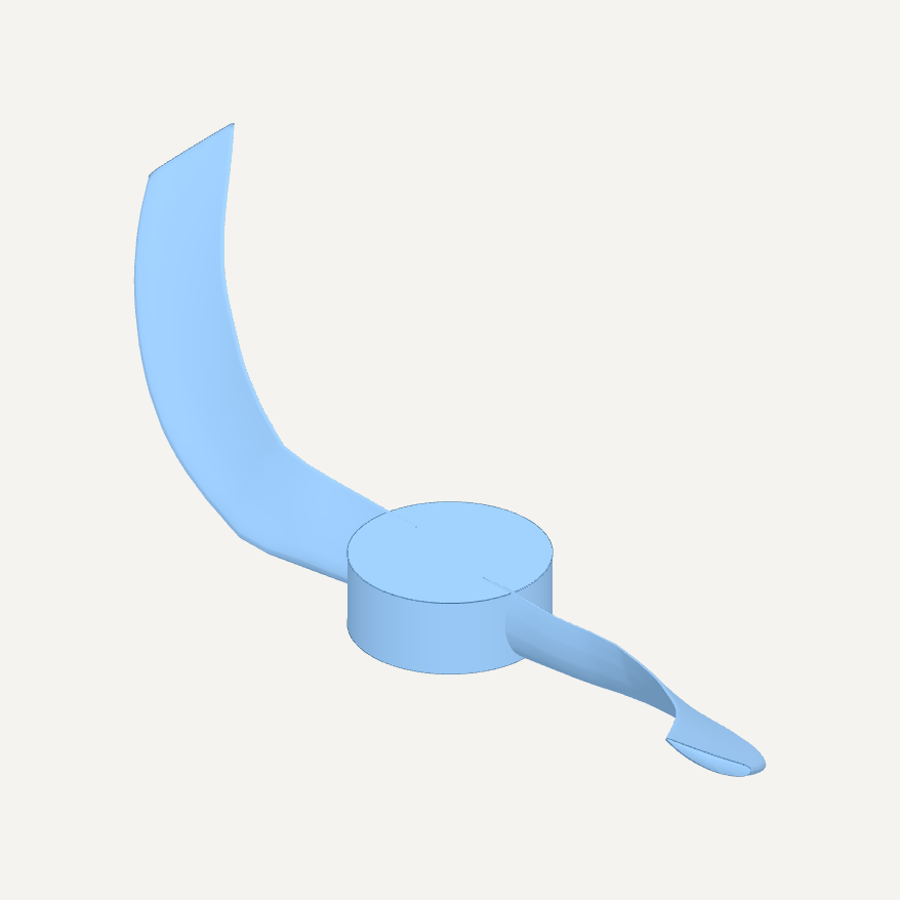
A 6:1 gear and a hub that twists the blades keep the motor efficient underwater. Six teams of agents then raced different shapes, and a swept blade borrowed from marine propellers won. Underwater power fell from 47.5 W to 3.91 W.
What went wrong
Its first answer optimized the wrong thing.
The first search tuned the blade on its own. Checked against the real motor, its score collapsed, so Archimedes rewrote the goal around battery power and searched again.
Archimedes: 12 h search + 8 h verification1,267 3D RANS solves on 12 cloud nodes (~$160 total)
One 254 mm rotor. One motor. Hover a 2 kg drone in air, propel it underwater at 1 m/s, and optimize the complete battery-to-thrust system, not a blade in isolation.
How the design came togetherfour decisions, step by step
How it works
Four decisions turn an air propeller that barely works underwater into one co-designed flight-and-swim system.
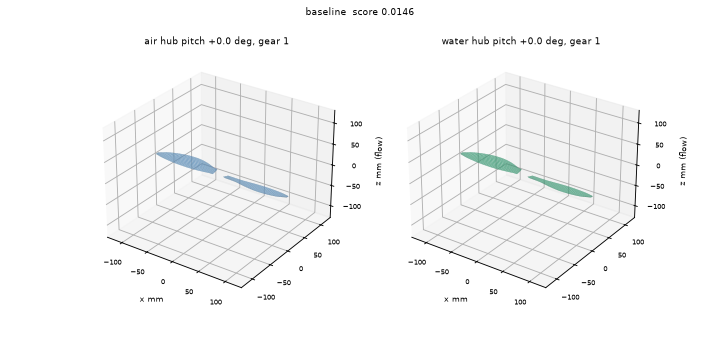
Baseline · direct driverecorded section rings · fixed camera
373 RPM15.2% motor η2.7% useful power
D = 254 mm · rotor axis normal to disk
Baseline · direct drive
The motor, not the blade, fails first.
Water torque pulls the motor down to 373 RPM. The drivetrain fails before blade geometry has room to matter.
Archimedes changed
Change the drivetrain objective from shaft efficiency to battery-to-thrust efficiency.
Reframe · gearbox + pitch
Separate motor speed from propeller speed.
A 6:1 reduction returns the motor to its efficient band. Rotating the blade +22.5° then aligns the hydrofoil with the steep underwater inflow.
Archimedes changed
Co-design gear ratio and collective pitch before searching blade shape.
Gen 264 · paddle leader
The wide blade fixes Reynolds number, then hits a vortex wall.
Full diameter and constant chord preserve low-Reynolds-number lift. The square unswept tip concentrates the pressure jump into a strong vortex core.
Archimedes changed
Keep disk area and chord, but change the stacking line at the tip.
Gen 1255 · scimitar winner
Sweep unloads the tip without surrendering disk area.
A 28° aft sweep, 3.7-4.5% outboard sections, and a final advance-ratio re-trim weaken the tip vortex while preserving attached low-Re flow.
Archimedes changed
The winning geometry combines mechanisms discovered on different evolutionary islands.
Headline numberswith the basis for each
91% / 89%of an air-only optimum's hover efficiency and a water-only optimum's cruise efficiency, achieved by one bladeFine-mesh 3D RANS CFD · full drive chain
9.2xunderwater battery-to-thrust system efficiency vs a stock drone propeller on direct drive (24.6% vs 2.7%)Fine-mesh 3D RANS CFD · 3.91 W vs 47.5 W
+10 to +14%full-chain score over the best standard propeller (APC 10x7) given the exact same variable-pitch hub and gearboxLike-for-like hardware benchmark
The search, replayed1,251 designs, generation by generation
The search
Each point is a solved rotor and drivetrain, not a generated shape. The search first recovered the motor operating point, then separated air and water pitch, before comparing topology on the complete battery-to-wake objective.
1,246 scored designs shown from 1,267 evaluations · exact metrics, generation order, and parent lineage from prop-run2. “Round” is a chronological 12-design replay batch because scheduler round boundaries were not exported; 16 unsolved records and five duplicate island baselines have no independent point.
The replay places every scored campaign design at its recorded air and water metric. New 12-design chronological batches appear together; the orange marker tracks the best score available at that point.
Approaches and the physical logicwhat each change bought
Approaches tried
The breakthrough was the order of operations: fix the motor, then incidence, then shape.
01
Recover the motor
Separate motor speed from rotor speed with a 6:1 water reduction.
55.88 W → 13.36 W02
Recover the blade
Give one rotor a different collective pitch in each fluid.
20.7% → 69.0% blade efficiency03
Recover the mission
Co-design sweep, sections, pitch, and gearing instead of optimizing a blade alone.
91% air optimum · 89% water optimum
The physical logic
Each intervention removes a different loss. Select a step to see the measured operating point; the charts retain every earlier configuration for comparison.
Fine-mesh CFD · full battery-to-thrust chain
+ Archimedes Gen 1255 Campaign Blade
Only after gearing and pitch were solved did blade shape become decisive. The swept rotor preserves air performance while reducing underwater profile and vortex loss.
Underwater operating point500 RPM motor floor shown as a rule
Propeller150 RPM
Motor898 RPM
Motor η 54.4% · blade η 78.5%
Recorded fine-mesh full-chain terms. Up is better; each step keeps the same battery-to-thrust accounting.
Air term Water term Full-chain score
Full-chain score0.3375Air 0.463 · Water 0.246
Water prop / motor RPM150 / 898Motor efficiency 54.4%
Water blade efficiency78.5%Recorded at the 1.50 N cruise operating point
Electrical power (1.5 N)6.09 W9.2× lower than stock
Battery power required for 1.50 N underwater thrustW per rotor · lower is better
Stock
55.88 W
+ Gear
13.36 W
+ Pitch
6.54 W
+ Blade
6.09 W
Motor ESC Gear Hub Propeller Useful thrust
Baseline vs winnerscores on the full drive chain
Baseline vs winner
The continuation winner is the final full-chain search result. Gen 1255 remains the distinct campaign blade used by the verification studies.
Configuration
Full-chain score
Role in the campaign
Stock APC 10x4.7, direct drive
0.0194
Failure-mode baseline: fixed pitch and 1:1 drive
Archimedes Gen 1255
0.3375
Campaign blade used for the verification studies
Archimedes continuation winner
0.3504
Distinct later winner from the full-chain continuation search
Gen 1255 campaign full-chain score: 0.3375. The 0.4446 grid-convergence value is a motor-chain verification score, not a full-chain score.
3D variant explorerspin every family's best blade
Explore every variant in exact campaign geometry
Every family starts from the same comparison view and scale. Drag to inspect its recorded section-ring geometry; reset before switching back to like-for-like comparison. The CFD tabs remain the computed flow evidence.
Recorded section rings · drag to inspect
Hub spindle pitch+27.1 deg · 6:1 gear
Scimitar / Skewedg1255_5a984309 · foil section
Scimitar / Skewed (Gen 1255 Winner)
Literature anchor: Boswell (1971) highly skewed marine series + thin low-Re aero section
28 deg aft scimitar sweep unloads tip cavitation and shock losses while thin 3.7-4.5% outboard foil sections operate at cl 0.57 (L/D 19) underwater at +27.05 deg hub pitch and 6:1 gearing.
Spawned at Gen 286 when an Island 1 agent grafted a 22 deg aft sweep law onto the Island 2 Rectangular Paddle leader; by Gen 1255 its code evolved into a coupled two-medium advance-ratio pipeline.
Live 0.75R hydrofoil physics (Water 1.0 m/s)Optimal hydrofoil L/D + motor band
0.75R lift / L/Dcl 0.45 · L/D 19
Prop / Motor RPM150 / 900 RPM
Motor / Blade eta54% / 79%
Battery-to-wake32.0%
Spanwise station laws (r/R = 0.15 to 1) Chord c/R Pitch(r) |Skew|
Technical reportbenchmark, verification and limits
What this unlocks
A vehicle can cross the air-water boundary without carrying one propulsion system as dead weight in the other medium.
One propulsion system, two operating worlds
The result is not merely a better propeller. It is a practical route to smaller aerial-aquatic vehicles for inspection, coastal science, search, and infrastructure work, found by agents that could test system-level ideas across mechanics and fluids in hours instead of handing each discipline a separate optimization problem.
91% / 89% of air-only / water-only optima55.88 → 6.09 W underwater battery draw0.3375 Gen 1255 campaign full-chain score0.3504 continuation winner full-chain score
Campaign record and appendicesdecision log, families, references
Campaign record and limitations
The brief, benchmark, decision log, population, numerical basis, verification evidence, and references, expanded in document order for human or agent review.
Same-hardware benchmark
Every standard rotor received the same variable-pitch hub and two-speed gearbox, with pitch and gear pairs retuned before fine-mesh comparison.
Rotor
Pitch, air / water
Gear, air / water
Full-chain score
Air FM
Water eta
Endurance, air / mixed / water
Wageningen B4-55 marine propeller (tuned on same hub & gearbox)
0.0 deg / 0.0 deg
3:1 / 6:1
0.2345
0.485
0.463
18.9 / 27.6 / 51.0 min
APC 10x4.7 SF air propeller (tuned on same hub & gearbox)
+4.5 deg / +22.5 deg
1.5:1 / 6:1
0.3025
0.701
0.690
25.8 / 45.2 / 181.2 min
APC 10x7 SF air propeller (best tuned standard propeller)
0.0 deg / +17.5 deg
1.5:1 / 6:1
0.3063
0.699
0.708
25.7 / 45.3 / 189.2 min
Archimedes Gen 1255 (scimitar / skewed, 2 blades, 254 mm)
Three systematically refined unstructured hex-dominant meshes per medium (g3 = 0.36M, g2 = 0.72M production fine, g1 = 1.5M cells) give Gen 1255's motor-chain verification score as 0.4473 / 0.4446 / 0.4425 (GCI_fine = 1.7%, +/- 0.0073). This is not the full battery-to-wake chain score.
The lead of Gen 1255 over the next topological family (Toroidal Loop g48 at 0.3769 +/- 0.0307) is 0.0656, which is 2.1x the combined discretization uncertainty (0.0316). Hover figure of merit converges to 0.8% GCI, and enlarging the computational domain by +50% in every direction shifts thrust, torque, and efficiencies by less than 0.7%.
Motor-chain verification score · cell count per medium
At underwater cruise (150 RPM), the blade chord Reynolds number is Re_0.7R ~ 22k-28k, where laminar separation bubbles can form. We validated a wall-resolved gamma-Re_theta transition model (y+ < 1) against UIUC wind-tunnel data (Deters, Ananda & Selig 2014) on DA4002 propellers at matched Re ~ 25k.
Across the advance-ratio sweep, the transition model predicts thrust within 4.5% RMS and efficiency within 5.5 points. Re-solving Archimedes' Gen 1255 blade with the wall-resolved transition model raises the motor-chain verification score from 0.4446 to 0.4593 (water blade efficiency 0.785 -> 0.824). These values are verification-chain metrics, not full-chain scores.
Low-Reynolds-number model sensitivityGen 1255 verification chain
Air FM
0.7080.7170.737
Water η
0.7870.8070.808
Score
0.4450.4510.459
WF / laminar / γ-Reθ transition, reconstructed from the recorded transition.json values.
Because thin outboard hydrofoils can twist under hydrodynamic load or fatigue in wet nylon, we ran 3D nonlinear CalculiX finite-element analysis using conditioned (wet) PA6-GF30 properties (E = 4.2 GPa, 10^7-cycle Goodman fatigue limit 22 MPa) and re-solved the elastically deformed shapes in CFD.
Sizing the inboard thickness schedule gives 0.4 deg of elastic twist at hover, a minimum Goodman fatigue safety factor of 1.85 across all four operating points, and first natural frequencies well clear of 1P and 2P excitation. The structurally sized blade scores 0.4363 on the fine mesh (+9.9% ahead of the best tuned standard propeller on the same chain).
0.4° elastic twist≥ 1.85 Goodman fatigue SF0.4363 sized-blade fine score
Using two-phase volume-of-fluid CFD (OpenFOAM interFoam) and a time-domain vertical exit trajectory integrator from depth z = -0.5 m to +0.5 m, we tested both static submergence sensitivity and dynamic water-to-air transition.
Submerged thrust and torque remain within 1% of deep-water values until the free surface comes within 0.25 D of the rotor plane. During breach at hover RPM, the air pitch setting delivers 0.82-1.06x its in-air thrust across the interface, and vertical exit succeeds at every ascent speed from 0.5 to 2.5 m/s with a gear/pitch shift up to 0.2 s at >= 4x thrust margin.
0.5–2.5 m/s successful ascent range≤ 0.2 s gear/pitch shift≥ 4× thrust margin
Appendices A-E
Nothing is collapsed. The recorded campaign material is exposed as raw content.
Appendix A: Brief, operating points, and score
The frozen problem statement and objective basis
Design a single propeller rotor (D <= 254 mm) and variable-pitch / two-speed drivetrain for a 2.0 kg aerial-aquatic quadrotor on a T-Motor AIR2216 II (KV920, 4S). Must hover in air at 4.90 N per rotor, pull 2g air climb at 9.81 N (tip Mach <= 0.6), cruise underwater at 1.0 m/s (1.50 N), and dash at 1.5 m/s (3.37 N, cavitation margin >= 1.2 at 0.5 m depth, PA-GF30 root stress <= 40 MPa). Maximize the geometric mean of air and underwater wire-to-wake efficiency.
Air hover: 4.90 N per rotor.
Air climb: 9.81 N per rotor, tip Mach at or below 0.6.
Water cruise: 1.50 N at 1.0 m/s.
Water dash: 3.37 N at 1.5 m/s with cavitation margin at least 1.2.
Objective: geometric mean of air and water wire-to-wake efficiency on the full drive chain.
Score labels are intentionally distinct: Gen 1255 is 0.3375 on the campaign full chain; the continuation winner is 0.3504. The 0.4446 value used in the grid and transition studies is a motor-chain verification score and is not interchangeable with either full-chain result.
Appendix B: Decision log
Observation, deduction, change, and measured result
Discovering why shaft-power optimization fails in water
Observation: Archimedes first evolved 1,197 conventional blades using blade-element momentum theory (BEMT) scored on shaft efficiency (reaching 0.512). When it audited its own winner against the full T-Motor AIR2216 II electrical model, the combined score collapsed to 0.1569.
Deduction: Why did a hydrodynamically 'efficient' blade fail on the real drone? At 1:1 direct drive in 830x denser water, hydrodynamic torque forced the rotor down to 373 RPM (below the motor's 500 RPM floor, 15.2% motor efficiency, 38.7 W burned as I^2R winding heat), while the blade sections operated at cl = 0.10 (L/D = 5).
Change and result: Reformulated the entire optimization around wire-to-water electrical power, introduced a 2-speed gearbox (1-6:1) and 90 deg variable-pitch hub travel, and switched the evaluator to 3D OpenFOAM MRF RANS in both media.
Seeding six competing geometries from aerospace & marine literature
Observation: A single parametric blade template cannot simultaneously explore closed MIT toroidal loops, shrouded Kort nozzles, CLT tip barriers, and swept scimitars without collapsing onto the easiest local optimum.
Deduction: To prevent premature convergence, Archimedes authored six distinct geometric seed programs grounded in published literature and isolated them on six evolutionary islands for the first 200 generations (~3 hours).
Change and result: Calibrated all 6 seeds in 3D RANS: Rectangular Paddle (s4, 0.3876), CLT End-Plate (s6, 0.3397), Scimitar Marine (s3, 0.3389), Toroidal Loop (s2, 0.3276), Conventional BEMT (s1, 0.2948), and Ducted Kort Nozzle (s5, 0.1953).
Immediate 6:1 water gear saturation & two-medium twist synthesis
Observation: In Gen 1-18, CFD feedback showed water was the limiting term (0.25 vs 0.46 in air), and shrinking rotor diameter below 254 mm penalized hover figure of merit (which scales with disk area).
Deduction: At Gen 9, an agent replaced hard-coded station arrays with an explicit two-medium twist synthesis model: setting blade twist beta(r) as a weighted blend of hover induced inflow arctan(v_i / omega*r) and water advance ratio arctan(J / pi*r) minus the collective hub offset.
Change and result: Water gear locked at 6.0:1, diameter expanded to the full 254 mm limit, and water hub pitch climbed from +14 deg to +25.6 deg on the untapered Rectangular Paddle line (Gen 264, coarse score 0.4353).
Grafting a 22 deg aft scimitar sweep onto the Rectangular Paddle leader
Observation: Once cross-island migration opened after Gen 200, an agent on Island 1 inspected the Gen 264 Rectangular Paddle leader from Island 2. While its wide outboard chord (c/R = 0.16) kept water Reynolds number high, its straight squared tip shed a strong tip vortex under water loading.
Deduction: Drawing on Boswell (1971) marine skew theory, sweeping the outer blade path aft (progressive skew outboard of 0.35R) aligns the tip leading edge obliquely to the local inflow, unloading tip-vortex losses and widening the cavitation bucket without sacrificing disk area.
Change and result: Synthesized Gen 286 by grafting a 22 deg aft scimitar sweep law onto the Paddle planform, jumping the score to 0.4381 and spawning the scimitar lineage that overtook all six islands (399 of 1,251 valid designs).
Observation: By Gen 914 (score 0.4577), tip skew opened to 28 deg on Island 5. Inspecting the Gen 1183/1230 CFD trims, the agent noticed the trimmed water advance ratio had drifted to J = 1.643, slightly unloading the outer sections.
Deduction: Thinning the 0.65-0.75R hydrofoil sections to t/c = 3.7-4.1% (just above the 0.92 mm structural thickness floor) cuts profile drag at Re ~ 25k, while a -0.15 deg water-hub re-trim pulls the trimmed J back to 1.600 - placing the 0.75R section dead-center on cl = 0.57, L/D = 19.
Change and result: Gen 1255 reached 0.4637 coarse / 0.4448 fine motor-chain (0.3375 full battery-to-water chain, and 0.3504 in the full-chain continuation run), cutting underwater electrical power to 3.91 W vs 47.49 W for the stock APC.
Proving 91% / 89% of single-medium perfection & structural/VOF sign-off
Observation: How much performance did Gen 1255 sacrifice by operating in both air and water? And would a 3.7%-thick blade twist or fatigue in wet nylon or fail when breaching the water surface?
Deduction: Archimedes launched five dedicated follow-up campaigns (air-only, water-only, toroidal-only, ducted-only, and full-chain continuation) plus four independent physics verification suites.
Change and result: Proved one blade reaches 91% of the air-only optimum and 89% of the water-only optimum; confirmed 1.7% GCI across 3 grids (up to 1.5M cells), 4.5% RMS thrust match vs UIUC low-Re wind-tunnel data, 0.4 deg hover twist & SF >= 1.85 in 3D nonlinear CalculiX FEA, and >= 4x thrust margin across two-phase VOF water exit.
Appendix C: Population and families
Search breadth and topology coverage
1,267 3D RANS evaluations across 6 topological families, run on 12 cloud machines.
Scimitar / skewed - Gen 1255 campaign geometry, 0.3375 full-chain
Conventional tapered - Gen 867, 0.3350 full-chain
Contracted-and-loaded tip - Gen 238, 0.3191 full-chain
Toroidal closed loop - Gen 48, 0.3008 full-chain
Rectangular paddle - Gen 264, 0.2768 full-chain
Ducted Kort nozzle - Gen 30, 0.2542 full-chain
Appendix D: Solver and uncertainty
Numerical basis and independent checks
Fine-mesh 3D RANS CFD (OpenFOAM MRF, k-omega SST) + full battery-to-wake drive chain
Three-grid convergence study (0.36M to 1.5M cells per medium): score converged to 1.7% GCI; lead over the next topological family is 2.1x the combined discretization uncertainty.
Matched-Re wind-tunnel validation against UIUC data at Re ~ 25k: wall-resolved gamma-Re_theta transition CFD predicts thrust within 4.5% RMS and raises Gen 1255's score from 0.4446 to 0.4593.
3D nonlinear CalculiX FEA with wet PA6-GF30 fatigue data: 0.4 deg hover elastic twist, Goodman fatigue safety factor >= 1.85, retaining a +9.9% lead over tuned APC 10x7.
Two-phase VOF water-surface breach: vertical exit succeeds across 0.5 to 2.5 m/s ascent speeds with a <= 0.2 s gear shift at >= 4x thrust margin.
Explicit limitations
The score and family ranking converge faster than absolute loads; the recorded fine-grid water-thrust GCI is 65%.
The search tier is about 10-15% optimistic in water. Reported finalist comparisons use the fine-mesh rescoring.
No structurally sized blade has yet been built and tested as a complete aerial-aquatic vehicle.
Low-Reynolds-number model sensitivityGen 1255 verification chain
Air FM
0.7080.7170.737
Water η
0.7870.8070.808
Score
0.4450.4510.459
WF / laminar / γ-Reθ transition, reconstructed from the recorded transition.json values.
Full-chain underwater power accounting
Configuration
Useful
Propeller loss
Hub / bearing
Gear
Motor
ESC
Battery total
Stock APC 10x4.7 on Direct Drive (Fixed 0 deg Hub)
1.497 W
5.731 W
0.001 W
0.000 W
40.272 W
8.379 W
55.879 W
+ Two-Speed Gearbox (1:1 Air / 6:1 Water)
1.497 W
5.731 W
0.001 W
0.822 W
3.889 W
1.416 W
13.356 W
+ Variable-Pitch Hub (+4.5 deg Air / +22.5 deg Water)
1.497 W
0.674 W
0.139 W
0.254 W
2.054 W
1.927 W
6.545 W
+ Archimedes Gen 1255 Campaign Blade
1.497 W
0.410 W
0.122 W
0.223 W
1.892 W
1.941 W
6.086 W
Appendix E: References
Source identifiers already present in the campaign record