Lid-driven cavity
The most reproduced test in computational fluid dynamics: a square box, a sliding lid, and half a century of published reference data to answer to.
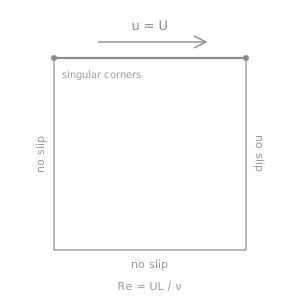
The problem
A square cavity is filled with fluid and the lid slides steadily sideways. Viscosity drags a primary vortex into the middle of the box, and as the Reynolds number rises, secondary vortices appear in the bottom corners and then a third in the upper left. The geometry is trivial and the boundary conditions are three still walls and one moving one, which is exactly why the case became the common currency of the field: there is nothing to get wrong except the physics.
It has no closed-form answer, so this is validation against published data rather than verification against a formula. The comparison is made on quantities everyone reports: the velocity profiles through the horizontal and vertical centrelines, and the position and strength of the primary vortex.
There is one honest subtlety, and it is the reason this case sits in the canonical group rather than beside the order-of-accuracy work. Where the moving lid meets the stationary side walls, the boundary condition is discontinuous and the pressure is formally singular. That corner limits the order of accuracy any scheme can demonstrate globally, however good the scheme is, so a clean second-order slope is only expected away from the corners. A case that reports a perfect global order here is measuring its own error metric, not the solver.
Boundary conditions (unit cavity, lid speed U)
What we will measure
The study will run the cavity at the Reynolds numbers the reference data covers, on a sequence of refined uniform meshes, and compare the computed centreline velocity profiles against the published values point by point. The primary vortex centre is located from the computed stream function and compared with the same quantity in the references.
Two things get measured separately. Agreement is how close the converged profiles sit to the published data, reported as the maximum difference along each centreline. Order of accuracy is measured only in the smooth interior, away from the singular corners, where a second-order scheme should still show a slope of two.
Published results are measured, not predicted. This page carries the problem, the boundary conditions, the reference data and the measurement plan; every number below stays marked pending until the runs are committed.
Reference data
This case has no closed-form answer, so the comparison is against published benchmark results rather than a formula.
- Ghia, Ghia & Shin (1982), “High-Re solutions for incompressible flow using the Navier–Stokes equations and a multigrid method”, Journal of Computational Physics 48, 387–411. The 129 × 129 tabulated centreline profiles for Re 100 through 10 000.
- Botella & Peyret (1998), “Benchmark spectral results on the lid-driven cavity flow”, Computers & Fluids 27, 421–433. High-accuracy spectral results at Re 1000, used as the tighter check.
Expected result
Nothing below is a measurement yet. The orders and comparisons are what this case is built to test, and each one stays marked pending until the runs are made and committed. Every number published elsewhere in this library traces to a run; these will too.
Velocity through the cavity centre, against published data
expected Within benchmark scatter→pending
Where the main recirculation sits, against published data
expected Within benchmark scatter→pending
Accuracy in space away from the singular lid corners
expected 2.00→pending
| Reynolds number | Reference | Mesh sequence | Status |
|---|---|---|---|
| 100 | Ghia et al. 1982 | 64² to 256² | pending |
| 400 | Ghia et al. 1982 | 64² to 256² | pending |
| 1000 | Ghia et al. 1982; Botella & Peyret 1998 | 64² to 512² | pending |
| 3200 | Ghia et al. 1982 | 128² to 512² | pending |
The planned test matrix, not a result. Higher Reynolds numbers need finer meshes to resolve the corner vortices, which is why the sequence starts later.